I don't plan a budget. I sorted that out when I bought the plane ticket.
An itinerary is never dogma. I actually break mine on the very first day. It might be because I skip some places, or because I change destination thanks to a different bus, a brilliant lift while hitchhiking, the weather or just my mood.
Then again, for me an itinerary is a kind of framework for the whole trip. So whether I'm planning a weekend break somewhere in Europe or a month-long backpacking trip, I always want to experience as much as possible without needlessly wasting time or money.
For planning I use two cloud tools which, by their very nature, are meant for completely different things, but they suit me (we're talking about google doc (spreadsheets), Google maps , mapy.cz and Miro). Yes, there are also dedicated online planners, but they're just too detailed / strict / restrictive / [insert whatever you like]
So let's get going..
So how do you go about it? First, let's answer the fundamental question…
Why is it good to have an itinerary (even if you might never stick to it)?
Honestly, I'm not a big fan of precise travel itineraries either. My travels are often full of chaos and chance. Even so, I'm convinced that a little planning and preparation can help turn a trip into an amazing experience.
The reality is that most people around me either plan in such detail that they never finish their itinerary, or leave everything to chance and have no plan at all. That doesn't mean they miss out on experiences, but they run into chaos more often. You can easily run out of time, the bus doesn't turn up, the place is closed or the hostel is full. And yet just a few hours of planning can help you avoid these nasty surprises.
So why not invest a little time in planning? I'm not saying you need every day planned down to the minute. It's enough to set a few key points and be ready for change. That, after all, is how I approach planning an itinerary
And if you're one of those who like to go wherever the wind takes them and don't worry about what tomorrow brings, then carry on not worrying. It has its charm 🙂
AND FINALLY. If the point of your trip is just lounging around a resort and relaxing, don't stress about planning. There are signs pointing to the restaurant and the beach bar, and if all else fails, the rep knows 😀
Incidentally, a word on how I plan and how I then follow it. The first image is the original final itinerary for Dominica and the second shows how it actually turned out. And I had to plan because of the ferry to Martinique (on the spot it turned out it could be moved by a day, which I didn't know beforehand) and also the weather on the Waitukubuli Trail.
And this is what the account of the trip looks like in reality (after getting back) – Dominica: a country (hardly) anyone flies or sails to
But actually, how do you do that itinerary, then?
Now I'll make use of what I'm sort of good at and try to visualise it as a process 🙂 or steps? Well, it doesn't really matter. So:
Destination info and highlights, or scouting the terrain
So now you know where you're going and for how long. You've got plane tickets or other tickets, which is a great start. Of course, if I'm going by car, it's all still a bit uncertain, but we won't deal with that now. Now it's time for more detailed research into the destination. That is, not just the quick initial look before buying the ticket (whether they'll even let you in, whether there's a revolution on or it's already over, whether the volcanoes are (not) erupting, etc.). How do I go about it? First I look at various travel blogs and online guides. That's a great start and can be incredibly useful. But beware, it can also be misleading.
And one more thing – the Ministry of Foreign Affairs website isn't always the best source, unless you're paranoid and looking for an excuse to bail on the trip and stay at home.
The advantage of researching and planning trips online is that I always find up-to-date, relevant information and can use reviews from people who've already been there. Googling "Things to do" or "Things to do in" shows me loads of fun activities and must-see places. That serves as the perfect template for building an itinerary. Other great sources are specialist websites such as lonelyplanet. com, travelbible. cz or dedicated travel groups on Facebook.
List of places: where and why, or at least links to places
The list. For some it's just points and bullets; for me it's actually a kind of cookbook. Above all, it gathers together all the things and places that interest me on the trip. At first it's always a very rough list that I keep adding to and rearranging. At the end of the day, the list is my main tool for organising activities and making sure I don't miss anything I want to experience. At least before I leave, because, as I wrote above, everything can be different on the ground.
But back to the list. I always build it so that each row represents one day on the trip. Then I split the cells into different categories:
- From, to and where I sleep: An overview of daily journeys and accommodation.
- Accommodation: Potential places to stay.
- Places of interest: Places I want to visit.
- Food and drink: Places where I want to try local specialities such as rum.
- Essential places: For example, offices for various permits and the like.
I also save links to interesting places in the Google Sheets list. As I wrote above, it's the ingredients list for the cookbook from which I then "cook up" the points on the map, the route planning and the consolidated overview of the trip in Miro.
Don't forget holidays and festivals
Planning a trip also means taking local holidays and festivals into account. These events can affect the availability of transport, the opening hours of sights and the availability of accommodation. Forgetting about Ramadan in Arab countries, for instance, can be pretty hellish. At the same time, holidays and festivals can offer me unique experiences and a chance to see local culture in full swing.
Priorities, oh those priorities
Your list of things you want to see will probably be far too long, and you'll have to set priorities. Colour-code your list and map to get an idea of what you don't want to miss and what you can skip. Setting priorities will help you focus on the most important places and activities.
Map of the route and points: visualisation rules the journey
The list is great for getting an overview of what you want to see, but it's not the best way to plan an itinerary for getting around. This is where Google Maps comes in. It helps me see transport options from place to place efficiently and clearly, and avoid needless downtime in places that aren't worth it. Or it might reveal that there's simply no short route between places. That's the reality of travelling.
On top of that, the map shows me other interesting places nearby or along the way, which makes it easier to decide where to head next and simply helps me not get lost in the middle of nowhere. On the road, the route planned in the maps lets me react quickly to changes and adjust it to current conditions or preferences.
Planning treks and trails is a problem of its own. Here I go with mapy. cz, because I see it as the best and almost ingenious basis for treks off the beaten track. In China, for example, it was actually the only option.
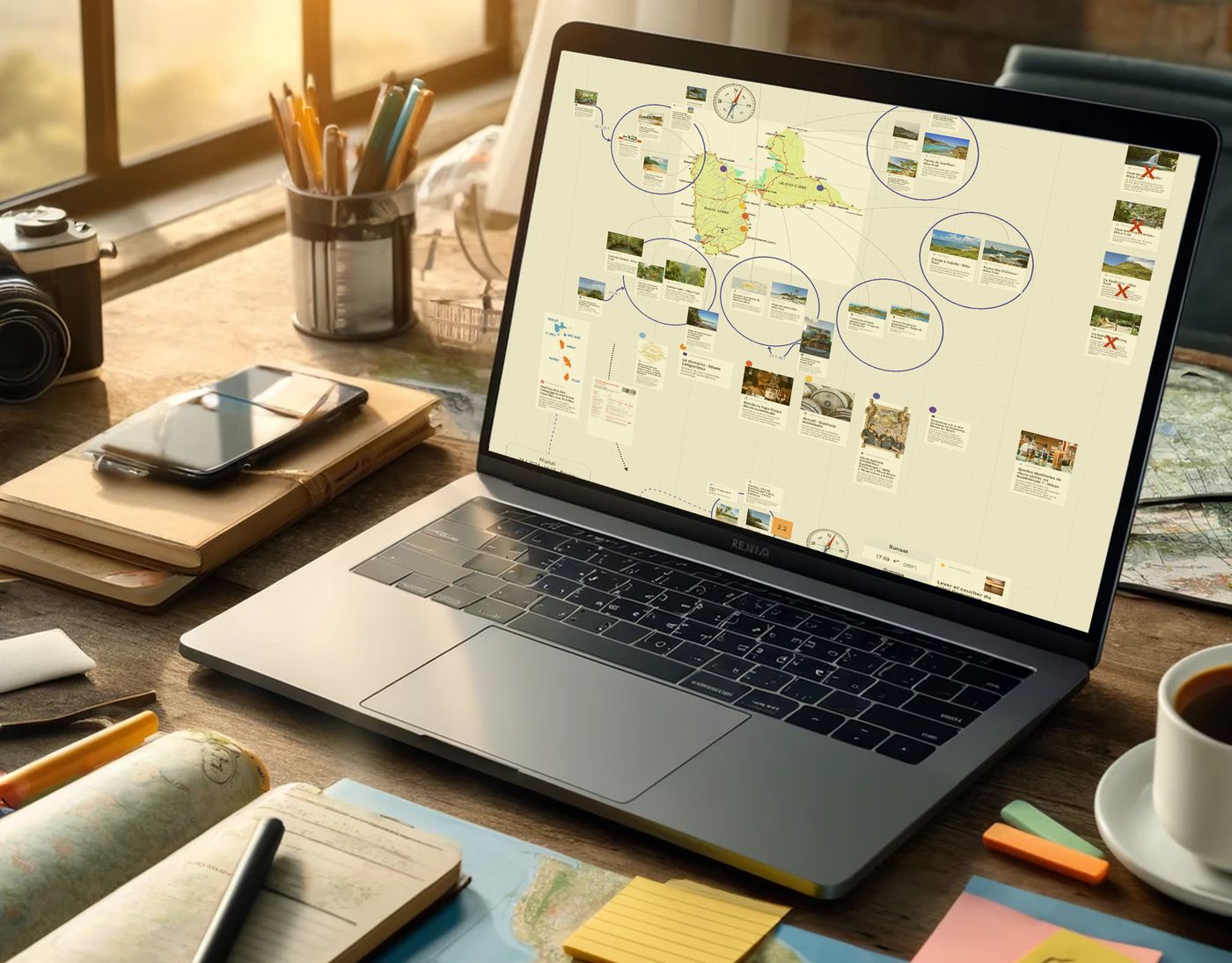
And finally, visualisation with a Miro board. In other words, complete consolidation of all the inputs
And finally, I create a comprehensive Miro board. It's a kind of overall signpost and overview of the trip. Into it I put all the important booking documents, links to interesting places, routes and other relevant information. It serves as a central place where you have all your materials together. This overview lets you plan and adjust your itinerary quickly and efficiently. With a Miro board you have everything to hand, which makes travelling easier and saves time hunting for documents.
Yes, we live in a digital age, but still. Isn't the greatest magic sitting over a trip plan with a printed guidebook based on the experiences of thousands of travellers and adventurers?…
It's probably nostalgia, but for me, yes.