Say Armenia and you might picture a biblical mountain, ancient monasteries or Armenian brandy. But this country has a few surprises up its sleeve too. From rural pastures where time has stood still to cities where a faint whiff of Soviet pomp hits you square in the nose, Armenia is a land of contrasts well worth experiencing. And I say that even though it's not exactly my favourite kind of tropics.
Picture lively cities full of cafés, markets and bustling streets that seem modern at first glance, yet in places feel as if time has stood still. In the shadow of prefab housing estates and monumental concrete buildings, Soviet pomp still breathes – broad boulevards, abandoned factories and statues recalling the bygone ambitions of the former regime.
And then comes the contrast. Just leave the cities and head into the mountains, where time flows differently. In quiet villages surrounded by vineyards and pastures, the world seems to have stopped. Here silence reigns, broken only now and then by the wind or the sound of bells from ancient monasteries that tell stories reaching back thousands of years.
Day 1 – Yerevan – Vanadzor
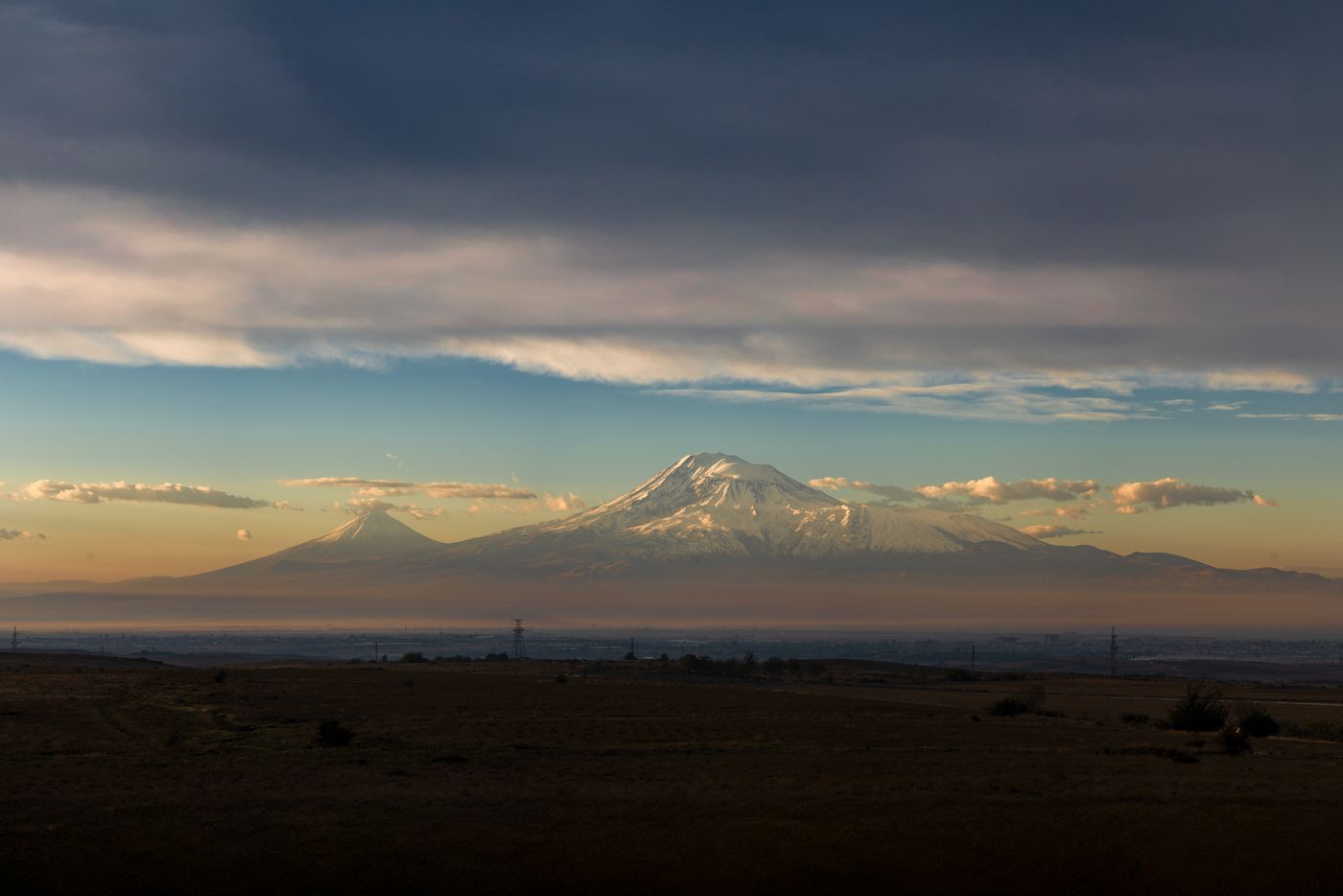
The first day of our Armenian trip began with landing in Yerevan after a flight from Vienna. Waiting for us at the airport was our hire car – a Soviet marvel of engineering called the Lada Niva. No sooner had we set off than an amazing show began behind our backs: a glorious sunrise, with the peaks of Greater and Lesser Ararat rising majestically on the horizon, bathed in golden rays. A perfect start! And at the same time a promise and a pledge from nature for the days ahead, when I'd set out to photograph Ararat. But I'm getting ahead of myself.
Our first stop was Hovhannavank Monastery, perched on the edge of the Kasagh River canyon. From there we carried on over the Debed pass (where it was a solid zero at the top) towards the town of Vanadzor. This is where we first caught that unmistakable breath of Soviet pomp: prefab housing estates, abandoned factories and crumbling industrial complexes that once produced textiles.
After a short two-hour rest at the hostel, we continued through the Lori valley to Alaverdi. There we visited Sanahin Monastery and the interesting Mikoyan Brothers Museum. Of the two, only the one behind the design and development of MiG fighter jets is interesting. The other? Honestly, he was a hardcore Bolshevik and not worth talking about…
In the evening we returned to Vanadzor, strolled around town and soaked up its calm atmosphere. To round off the day, we had a delicious lula kebab at one of the local kiosks.
Day 2 – Vanadzor – Areni
The second day of our trip began with a freezing morning in Vanadzor – the thermometer read minus two. But the sun was warm, and first thing we bought a coffee from a street vending machine for 100 drams (well, coffee for me, hot chocolate for Sebastian), which got us back on our feet.
We set off towards Lake Sevan. Past Dilijan we had breakfast at a fairly large roadside restaurant, where we came across perhaps the most polished Lada we'd ever seen. It was on display by the entrance like a jewel. After eating we continued to Sevanavank Monastery, which rises on a peninsula in the lake. The view was stunning – a glittering expanse of water surrounded by snow-capped mountains. If only it weren't for all the Russians around… but hey, you have to get used to that here.
Our next stop was Noratus Cemetery, a historic graveyard full of ancient khachkars. A little past Noratus we stopped at Mikayelyan Family Farm, where we tasted superb homemade cheese and bought dried meat for the road.
From the shores of Sevan we headed into the mountains towards the Sulemayi Lerrnants’k‘ pass and Orbelian Caravanserai, an old caravan stop. The drive was beautiful, with views of mountain peaks and valleys that never stopped delighting us.
To finish the day we still managed a visit to Noravank Monastery. We arrived just as the setting sun was creating beautiful lighting effects on the surrounding cliffs. It was a perfect end to the second day of our Armenian trip. Then just a short hop to Areni, dinner and bed.
Day 3 – Areni – Garni – Yerevan
We started the third day of our trip early in the morning in Areni. After a quick breakfast we jumped into our Lada Niva and set off towards Yeraskh. The road took us past Hells Canyon and through the area near Karki, an Azerbaijani enclave inside Armenia, where the landscape began to open up. In Yeraskh, a border town with Azerbaijan and just a stone's throw from the border with Iranian Kurdistan, both Ararats revealed themselves in all their glory. They really are majestic. Our next stop was Khor Virap, where I was drawn by that iconic view – the monastery set against Ararat, looking as if it's guarding the whole landscape. This view is simply a classic and something of a symbol of the whole region.
We carried on along the road towards Lake Azat. At one of the stalls we bought excellent dried fruit – plums, apricots, peaches – plus some wild dried mint. From Azat we headed to Garni, where we looked round the ancient temple, but in the end we skipped a visit to nearby Geghard Monastery. The crowds of tourists and daylight-robbery parking prices quickly convinced me it would be better to head straight to Yerevan.
In the evening in Yerevan we stopped at the Yerevan City supermarket to stock up on supplies. Then a little while on the illuminated Republic Square, where we just sat and soaked up the atmosphere of the city at night, and then it was off to bed.
Day 4 – Khor Virap – Yerevan
We began our fourth and final day in Armenia really early, because the goal was clear – sunrise lighting up Ararat and Khor Virap. We race through darkened Yerevan, still fast asleep. We arrive, it's 6:30, minus 5 degrees, and the show begins. And it's worth it.
We head back and after breakfast set off to visit the Ararat factory. Mount Ararat is the symbol of the whole country, but the same name is also borne by the legendary brandy. Our next stop was the biggest market in Yerevan – the Armenian Market. It has everything, from vegetables, herbs, spices and dried fruit to cheeses, fresh meat and fish from Lake Sevan. The journey to the market clearly shows that a living legacy remains in Armenia – we passed buildings bearing clear traces of the Soviet era: stars, hammers and sickles, and monumental statues. Some dated from that time, others were newer but had kept that distinctive character. For lunch we stopped at the cosy Mirzoyan Library café. It was a great chance to enjoy some peace and good food before exploring the city further.
In the afternoon we visited the ancient ruins of the fortress city of Teishebaini, which tell stories of the Kingdom of Urartu, and stopped at the Armenian Genocide Memorial, which recalls another, darker story. In the evening we enjoyed Armenian cuisine one last time at Anteb restaurant and then headed to the airport.